Blood Lines and Blue Notes: Mapping the Hidden Genealogy of Jazz Improvisation
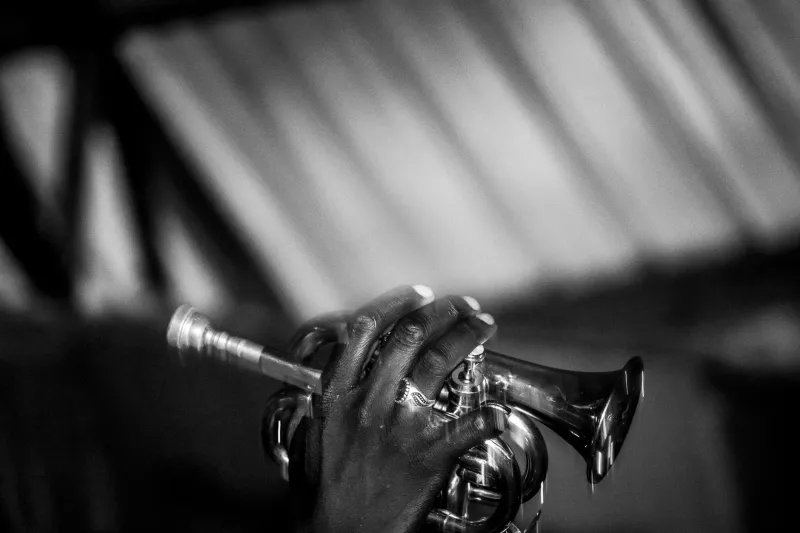
When Ambrose Akinmusire steps to the microphone and releases a tone that seems to hover between grief and wonder, few listeners think about Lee Morgan. When Christian McBride locks into a walking bass line so authoritative it feels geological, not everyone traces the thread back to Paul Chambers. Yet those connections are real, consequential, and as intimate as anything passed between members of a family. Jazz is, at its core, an inherited art — and the lineage runs far deeper than most listeners ever discover.
Unlike classical music, where influence is codified in scores and syllabi, jazz transmits itself through listening, imitation, and something closer to osmosis. The result is a sprawling, largely undocumented genealogy that links today's most celebrated performers to foundational voices many contemporary audiences have never encountered. Understanding those connections does not merely satisfy historical curiosity. It fundamentally changes how one hears the music.
The Invisible Curriculum
Formal jazz education — at institutions such as Berklee College of Music, the New School, and the Juilliard School — provides students with theory, technique, and exposure to canonical recordings. But veteran musicians frequently describe a second curriculum operating beneath the official one: the hours spent alone with records, the whispered recommendations passed from mentor to student, the slow absorption of phrasing that happens not through analysis but through repetition.
Tenor saxophonist Ravi Coltrane has spoken in interviews about growing up surrounded by his father's music, yet also discovering players like Pharoah Sanders and Joe Henderson as distinct voices whose influence shaped his own sound independently of John Coltrane's towering legacy. That kind of lateral inheritance — absorbing influences from a predecessor's peers rather than the predecessor alone — is common in jazz and rarely acknowledged in liner notes or artist biographies.
The same phenomenon appears across instruments and eras. Guitarist Kurt Rosenwinkel's unmistakable tone and harmonic language carries traces of Jim Hall, Wes Montgomery, and Pat Metheny, yet also reveals deep engagement with pianists — Bill Evans in particular — whose voicings Rosenwinkel translated across instrumental registers. This cross-instrument inheritance is one of jazz's most distinctive features and one of its least-discussed.
Tracing the Rhythmic DNA
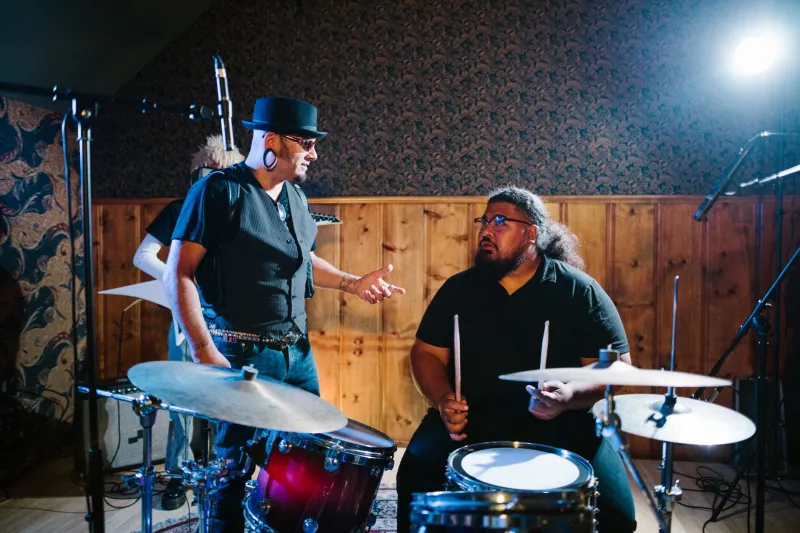
If melodic phrasing constitutes one strand of jazz's genetic material, rhythmic conception constitutes another — and it travels through generations with equal fidelity. The loose, conversational swing that defines the drumming of Brian Blade carries the cellular memory of Elvin Jones, whose own polyrhythmic innovations drew directly from the Afro-Cuban and West African traditions that circulated through New York's mid-century musical communities.
Consider the lineage embedded in a single rhythmic figure. The particular way a drummer might displace a snare accent to create tension across a bar line can be traced from contemporary players back through Tony Williams, back further to Max Roach, and further still to the New Orleans parade traditions that informed early jazz drumming in the first decades of the twentieth century. The figure has mutated across that span — absorbed new influences, shed others — but its ancestry remains audible to trained ears.
This is what makes jazz genealogy such a rewarding pursuit for devoted listeners. The music is not merely historical in the sense of being old. It is historical in the sense that the past is literally present inside every improvised phrase.
The Unacknowledged Ancestors
Perhaps the most striking aspect of jazz's invisible genealogy is how frequently the deepest influences belong to artists who never achieved mainstream recognition. The pianist Herbie Nichols, who died in 1963 having recorded only a handful of albums, exerted an influence on subsequent generations of jazz pianists that far exceeded his commercial profile during his lifetime. Musicians including Misha Mengelberg and Roswell Rudd championed his work posthumously, ensuring that Nichols's angular, idiosyncratic harmonic sensibility entered the broader stream of jazz vocabulary.
Similarly, the bassist and composer Charles Mingus drew extensively from the work of pianist and composer Jelly Roll Morton — a figure whose significance to jazz architecture Mingus discussed openly, even as Morton remained undervalued in mainstream jazz criticism. That kind of deliberate resurrection, one artist insisting on the importance of another, is itself a form of genealogical transmission.
For listeners seeking to understand the music they love more fully, these unacknowledged ancestors represent some of the richest territory available. Following the thread from a contemporary favorite back through two or three generations frequently leads to recordings of extraordinary quality that have simply never received the promotional infrastructure required for wide discovery.
Mapping Your Own Listening Lineage
The practical question for jazz aficionados is how to begin tracing these connections deliberately. Several resources have emerged to assist in this process. The musician and educator Ted Gioia maintains extensive historical writing that maps stylistic evolution across eras. The Jazz Discography Project provides detailed recording histories that allow listeners to track which musicians appeared together and when. Liner notes from the Blue Note, Prestige, and Impulse! catalogs — available through many libraries and digital archives — frequently contain candid discussions of influence that artists were less guarded about in earlier decades.
Beyond formal resources, the most reliable method remains the one jazz musicians have always used: following the recommendations of trusted voices. When a musician whose work you admire discusses a predecessor with evident reverence, that reverence is data. It points toward something that shaped the sound you love.
The Living Transmission
Jazz genealogy is not merely a historical exercise because the transmission is ongoing. Artists working today are depositing new material into the lineage — phrases, rhythmic approaches, tonal concepts — that younger musicians are already absorbing and transforming. The halo of influence that surrounds any significant jazz artist does not diminish after their most celebrated recordings are complete. It continues to radiate forward through every musician who listened closely enough to internalize what was being offered.
This is, ultimately, what distinguishes jazz from art forms that treat influence as a matter of academic citation. In jazz, influence is metabolized. It becomes flesh — or, more precisely, it becomes breath, and the breath becomes sound, and the sound enters the room and finds the next listener, the next student, the next musician who will carry some fragment of it forward into music not yet imagined.
The genealogy is invisible only until you begin to look for it. Once you do, it is everywhere.