Common Ground, Open Chord: The Jam Sessions Quietly Bridging America's Racial Divide

Photo: Holger Krisp, CC BY 3.0, via Wikimedia Commons
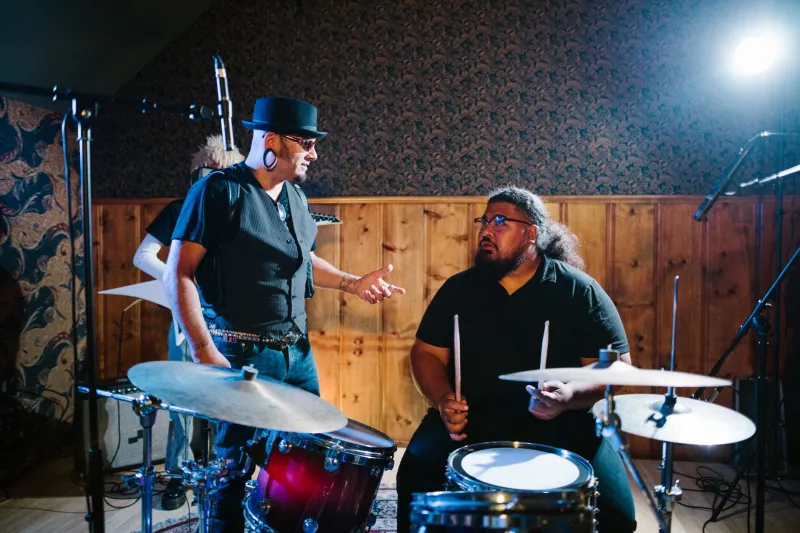
On a Tuesday evening in a converted warehouse space on Chicago's South Side, something unremarkable and extraordinary is happening simultaneously. A white guitarist from Lincoln Park is trading fours with a Black tenor saxophonist from Bronzeville. A Latino bassist anchors the rhythm while a Korean-American drummer from Evanston navigates a shifting tempo. The audience — a mix of ages, races, and apparent economic backgrounds — leans forward at roughly the same moment, responding to the same musical event.
No one organized this particular configuration of people. No grant funded it. No diversity initiative produced it. It emerged, as it has for decades, from the logic of the jam session itself: the implicit social contract that anyone who can play, plays, and anyone who listens, belongs.
Jazz and the Long History of the Integrated Room
To understand why jam sessions carry this particular social charge, it is necessary to understand what they have historically represented in American culture. The jam session emerged in the 1930s as an informal after-hours gathering — often held after paying gigs concluded — where musicians could experiment, challenge one another, and play free from commercial constraints. From their earliest iterations in Kansas City and Harlem, these sessions were among the most consistently integrated spaces in a rigidly segregated country.
This was not incidental. Jazz, as a music born from the convergence of African American musical traditions with European harmonic structures and a distinctly American cultural context, has always existed at the intersection of racial identities. The music did not merely tolerate integration; in many respects, it demanded it. The vocabulary of jazz — its harmonic language, its rhythmic sensibility, its improvisational ethos — was developed collaboratively across racial lines, even when the society surrounding those collaborations was doing everything in its power to enforce separation.
The club owners who permitted integrated audiences in the 1940s and 1950s were often doing so in defiance of local ordinance or social convention. The musicians who shared bandstands across racial lines were making a statement, whether they described it in those terms or not. Jazz has always been, among other things, a practice of radical togetherness.
What the Sessions Look Like Now
Decades removed from Jim Crow and the formal structures of legal segregation, the racial geography of American cities remains deeply and stubbornly unequal. Residential segregation, while no longer legally enforced, persists through economic mechanisms that produce effectively similar outcomes. In cities like Chicago, Detroit, Baltimore, and Atlanta, the racial and economic composition of neighborhoods remains strikingly consistent — and the social spaces those neighborhoods produce tend to reflect that composition.
Against this backdrop, the contemporary jazz jam session occupies a genuinely unusual position. Because jazz venues — particularly those that host open jams — tend to draw from across a city's geography, they frequently produce rooms that do not reflect the segregated neighborhoods surrounding them. This is especially true of sessions held in transitional neighborhoods, arts districts, or venues that have cultivated reputations as musically serious spaces rather than neighborhood bars.
In Detroit, a weekly session held at a venue in the Corktown neighborhood has become notable precisely for the demographic breadth of its regular attendees. The organizer, a veteran bassist who has played in the city for over thirty years, described the session's composition in terms that reflect both its significance and its ordinariness. "People come because the music is good," he said. "They stay because they feel welcome. After a while, you stop noticing what anyone looks like because you're listening to what they play."
In Atlanta, a monthly session organized by a collective of younger musicians in the Old Fourth Ward has explicitly positioned itself as a community event rather than simply a musical one. The organizers distribute flyers in multiple neighborhoods, partner with local restaurants and community organizations, and maintain a deliberately low cover charge to ensure economic accessibility. The session draws musicians and listeners from across the city's racial and economic spectrum — a feat that few other cultural events in Atlanta can claim with comparable consistency.
The Role of Musical Language
What makes the jam session particularly effective as a social bridging mechanism — as opposed to, say, a panel discussion or a community meeting — may be precisely its non-verbal nature. Jazz improvisation operates through a shared musical language that is learned and understood regardless of spoken language, cultural background, or social identity. When musicians engage in the call-and-response of a shared solo, they are communicating in a medium that bypasses many of the social scripts and anxieties that govern interracial interaction in other contexts.
Several participants in sessions across different cities described this dynamic in similar terms. A young white musician who had recently moved to Baltimore from a small town in Ohio described his first experience at a predominantly Black jam session in the city as the most natural interracial social experience of his life. "I didn't know how to talk to people," he admitted. "But I knew how to play. And once I played, none of the other stuff mattered."
A Black saxophonist who regularly attends the same session offered a more measured perspective. "The music creates a space," she said. "But it doesn't solve anything by itself. The relationships you build at the session — those are what matter. The music just gets you in the room."
This distinction is important. The jam session is not a magic solution to the structural inequalities that produce racial division in American cities. It does not redistribute wealth, integrate neighborhoods, or address the systemic forces that shape racial experience in this country. What it does — and what it has done consistently for nearly a century — is create conditions in which genuine human connection across racial lines becomes not merely possible but natural.
Organizers as Community Architects
The individuals who run these sessions often describe themselves primarily as musicians rather than community organizers, but their work functions as both. The decisions they make — about venue, pricing, programming, and outreach — shape the social composition of the room as surely as any formal community development initiative.
In Kansas City, where the jam session tradition runs deep and the city's jazz history provides a kind of civic mythology, several session organizers have begun explicitly documenting the demographic impact of their events. One organizer, who runs a weekly session in a neighborhood that sits at the boundary between predominantly white and predominantly Black residential areas, described her work as "holding the door open." "The music was always going to bring people together," she said. "My job is just to make sure the door is wide enough for everyone to walk through."
This is, perhaps, as accurate a description of the jam session's social function as any. The music provides the invitation. The organizers provide the architecture. And the musicians — trading phrases across whatever distances separate them — provide the proof that the invitation was genuine.