Painted in Sound: The Jazz Musicians Who Experience Music as Color

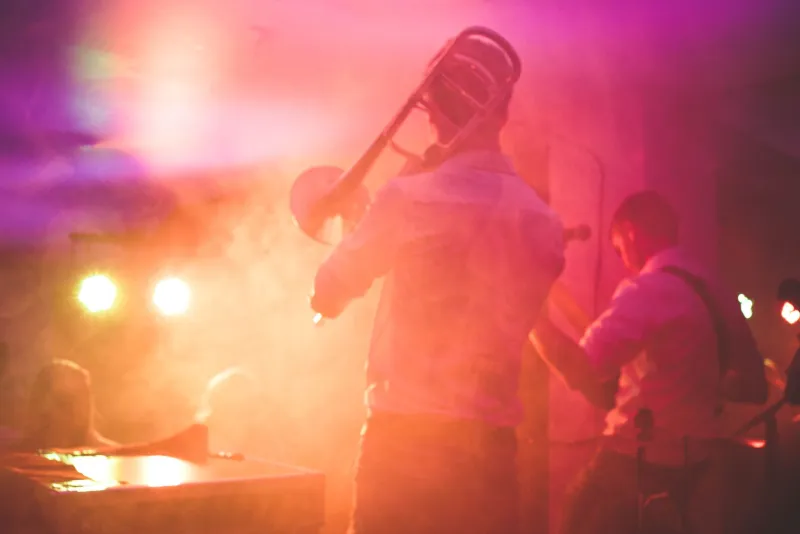
Photo by Photo by David von Diemar on Unsplash on Unsplash
For most listeners, jazz arrives through the ears and settles somewhere in the chest. But for a select group of jazz musicians, the music lands differently — it appears. Notes materialize as washes of amber or violet. Chord changes sweep across the inner eye like weather systems. A minor seventh might be the precise shade of a winter sky just before snow.
This is the world of the synesthetic jazz musician, and it is a world that raises profound questions about creativity, improvisation, and the nature of musical intelligence.
What Synesthesia Actually Is
Synesthesia is a neurological condition in which stimulation of one sensory pathway automatically and involuntarily activates another. The most commonly documented form, chromesthesia — or sound-to-color synesthesia — causes individuals to perceive colors in response to auditory input. It is not metaphor. It is not poetic license. The colors are experienced as genuinely present, overlaid on or adjacent to the perceived sound.
Research suggests that synesthesia occurs in roughly three to four percent of the general population, though some studies place the figure higher among artists, musicians, and writers. Duke University neurologist David Eagleman, who has studied the condition extensively, has noted that synesthesia appears to be significantly more prevalent among creative professionals than in the broader public — a finding that raises the intriguing possibility that sensory cross-wiring may confer certain cognitive advantages in artistic domains.
But jazz, with its unique demands on real-time decision-making and harmonic complexity, presents a particularly fertile environment for exploring what those advantages might look like in practice.
The Improviser's Inner Canvas
Consider what jazz improvisation actually requires. In any given moment, a soloist must navigate chord changes, respond to the rhythm section, communicate with fellow musicians, recall melodic vocabulary, and simultaneously generate something original. The cognitive load is extraordinary. Any additional layer of perceptual information — even one as unusual as involuntary color perception — could plausibly influence the choices a musician makes in real time.
Several working jazz musicians have described their synesthetic experience in terms that suggest it functions almost as an additional navigational tool. One pianist based in Chicago described the key of D major as consistently appearing to her as a warm, saturated orange, while the relative minor — B minor — arrives as a cooler, grayer version of the same hue. When she modulates between the two, she experiences what she calls "a color shift," a visual cue that both confirms and anticipates the harmonic movement. "It's like having a second map of the music running alongside the one I learned in school," she explained during a recent conversation. "I don't always follow it, but it's always there."
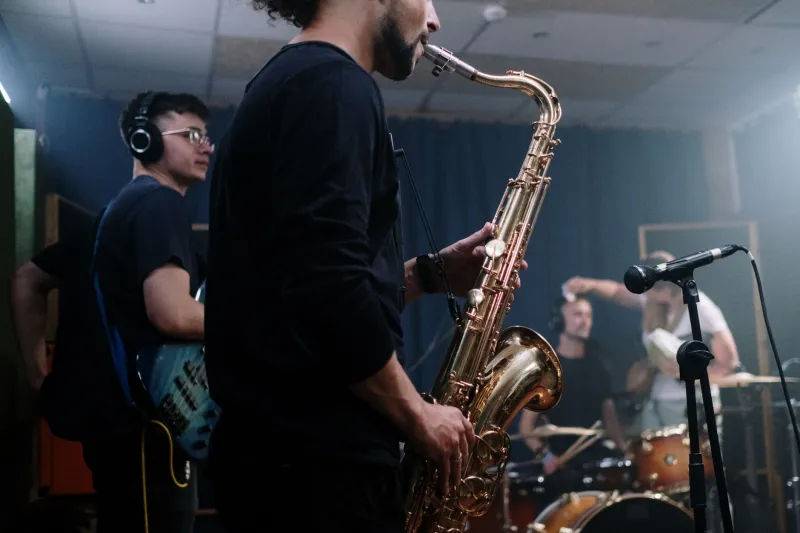
A Brooklyn-based tenor saxophonist offered a different account. For him, the colors are less tonal and more rhythmic. Straight-eighth-note passages appear as clean, horizontal bands of blue. When the rhythm becomes more syncopated — when swing feel deepens — those bands fragment and warm, shifting toward reds and oranges. He described using this internal visual field as a kind of emotional barometer during performance. "If the music is getting too cold, too academic, I can actually see it," he said. "The colors tell me before my ears do."
Is Jazz More Synesthetic Than Other Genres?
No rigorous clinical study has yet established whether jazz musicians experience synesthesia at higher rates than, say, classical performers or rock guitarists. The research that exists tends to examine musical training broadly rather than by genre. However, there are compelling theoretical reasons to suspect that jazz's particular demands may attract or cultivate synesthetic musicians at an above-average rate.
Jazz places an unusual premium on improvisational fluency — the ability to generate coherent musical statements without a written score, in dialogue with other performers, under conditions of constant harmonic change. If synesthetic color perception functions as an additional layer of real-time musical information, it may provide a meaningful edge in precisely those high-pressure, split-second decision contexts that jazz uniquely demands.
Dr. Psyche Loui, a neuroscientist at Northeastern University who studies the relationship between musical training and brain connectivity, has noted that the brains of trained jazz musicians already show unusual patterns of cross-modal integration — meaning the auditory and motor systems are more tightly linked than in non-musicians. Whether synesthesia amplifies or interacts with these existing neural architectures remains an open and genuinely exciting research question.
The Compositional Dimension
Beyond improvisation, synesthesia appears to influence how certain jazz musicians approach composition and arrangement. Duke Ellington — one of the most architecturally sophisticated composers in jazz history — is widely believed to have experienced some form of synesthesia. He described specific musicians' sounds in color terms throughout his life, referring to the tone of his valve trombonist Juan Tizol as "a mellow cello sound" that he associated with particular visual textures. Whether this constituted clinical synesthesia or a highly developed metaphorical sensibility remains a matter of some debate among music historians, but the pattern is suggestive.
More recently, composers working at the intersection of jazz and contemporary classical music have begun explicitly incorporating synesthetic frameworks into their work. Some have developed color-coded notation systems. Others have structured albums so that the harmonic arc of the record mirrors a deliberate progression of colors — a kind of sonic painting executed across an entire listening experience.
What It Reveals About the Music Itself
Perhaps the most significant insight offered by synesthetic jazz musicians is not about neurology at all. It is about the nature of jazz as a form of communication that exceeds language and even, in some respects, sound itself. When a musician describes hearing a chord change and simultaneously seeing it as a shift from gold to deep blue, they are pointing toward something that jazz has always suggested: that the music operates on multiple registers of human perception at once.
For the listener who does not experience synesthesia, this is not cause for exclusion but for expansion. The colors these musicians see are, in a sense, made audible in the music they create. When the Brooklyn saxophonist allows his internal visual field to guide him toward a warmer, more syncopated passage, the audience hears the result of that guidance — even if they cannot see what he sees.
Jazz has always been a music of translation: of grief into swing, of history into harmony, of community into counterpoint. Synesthesia, it turns out, may be one more remarkable mode of translation — a private language of color that finds its way, inevitably, into the shared language of sound.